Music Composition, Transdisciplinary Collaboration, Live Electronics, Electroacoustic, Digital Art, Harvard, Art, Composer, Compositor, Interdisciplinary, Collaboration, Cooperation, 60 Minutos por México
This website is a sort of a music diary where I share music, videos, ideas, current and future projects, dreams and everything that comes to mind. I’m thankful and glad that you are here. You can hear about news and concerts in the BLOG section of this website. This website is focused on my music [...]
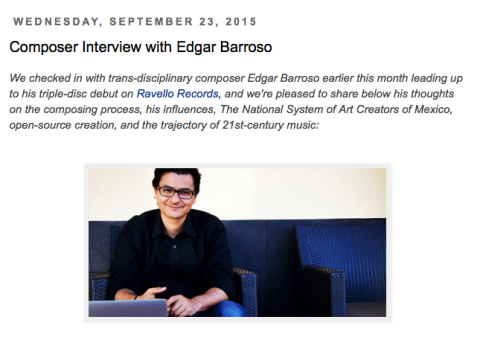
As mentioned before the study and practice of Transdisciplinary Collaboration is of tremendous importance in my life. During my time at Harvard I founded various collaboration groups with graduate students coming from many different fields of knowledge. We called it the “Open Source Creation Group” which was a cluster of Harvard Graduate and Undergraduate students [...]
My writing focuses on the exploration of how trans-disciplinary collaboration, sound physicality, and social context influenced the resulting sound. Almost every new work of music that I write, becomes an opportunity to create a community based environment with experts in fields other than music. This collaborative approach is crucial to be able to explore new [...]
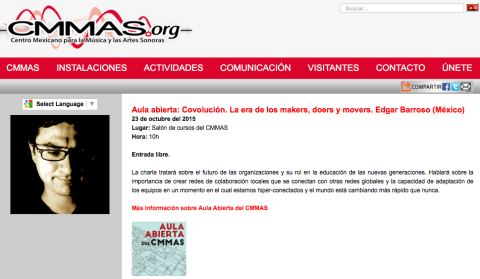
Social commitment is also an essencial part of my life. Using the skills I have learned from years of studying collaboration have helped to create a nationwide community of responsible citizens involved in the betterment of social issues in modern Mexico. We have several projects such as “60 Minutos por México”. An initiative that has [...]
Eight students named as finalists by Harvard Horizons, the new GSAS initiative to celebrate the insights and innovations of Harvard’s PhD community
The Graduate School of Arts and Sciences is pleased to announce the 2013 Horizon Scholars, eight PhD students whose ideas, innovations, and insights have the potential to reshape their disciplines. These students have been selected by the Harvard Horizons initiative as representatives of the high aspirations and the extraordinary achievements of Harvard University’s PhD programs. They form the inaugural class of the Society of Horizon Scholars, a new fellowship cohort that will offer opportunities for long-lasting community, mentorship, and professional and academic growth. Over the next month, these scholars will receive in-depth mentoring on the art of effective presentation, preparing them for a campus-wide symposium on May 6, at 4:30 p.m. in Sanders Theatre.
The Inaugural Horizon Scholars
and their project titles:
Edgar Barroso, Music “Enhancing Music, Social, and Entrepreneurial Innovation through Trans-Disciplinary Collaboration”
Stephanie Dick, History of Science “Aftermath: Following Mathematics into the Digital”
Alex Fattal, Anthropology “Guerrilla Marketing: Information War and the Demobilization of FARC Rebels”
Hansun Hsiung, East Asian Languages and Civilizations “Textbook Enlightenment: Europe, Japan, and the Global Book Trade, 1720–1877”
Fenna Krienen, Psychology “What We Can Learn From the Human Connectome”
Aaron Kuan, Applied Physics “Graphene Nanopores for Single-Molecule DNA Sequencing”
Liz Maynes-Aminzade, English “Macro-Realism: How Fiction Can Help Us Understand an Interconnected World”
Jeff Teigler, Division of Medical Sciences “Building Better Vaccines by Learning the Language of the Immune System”
The Horizon Scholars will present their ideas in compelling, short-format talks at the Harvard Horizons Symposium on May 6, at 4:30 p.m., at Sanders Theatre. Provost Alan Garber, FAS Dean Mike Smith, and GSAS Dean Xiao-Li Meng will join in the celebration, and faculty, staff, and students from across the University are invited to attend as well, and to stay for a reception after the symposium. Free tickets will be available at the Harvard Box Office and at the door at Sanders Theatre. (More information to follow.)
The inaugural class of Horizon Scholars was selected by Harvard Horizons, an initiative of Dean Meng and Shigehisa Kuriyama, Reischauer Institute Professor of Cultural History at Harvard.
Fifty-five PhD students applied to Harvard Horizons in February, submitting synopses of their most essential research ideas and short video of themselves presenting their work. A cross-disciplinary faculty committee reviewed the applications, selected 15 semi-finalists, and conducted a round of interviews, after which the committee met to choose the eight Horizon Scholars.
Mixtur is a collective formed in Barcelona with the aim of contributing to the creation, pedagogy and diffusion of today’s music and sound art, engaged with research, both related to the sound itself and it’s interaction with other disciplines.1
The metric expansion of space is the increase of distance between distant objects in a space that is constantly expanding, like the universe. Even though the universe is expanding, is not expanding into anything outside of itself. I imagine this expansion as very violent and extreme. The piece expands certain material into itself, a sort of a force that is trying to reach the unreachable, but has no place to go but to return to his own mass. With an obsessive obstinate rhythmic structure and with spasms of energy that revolves in its own velocity, range and capacity, the accordion becomes a machine which receives a non-stop stream of energy from the player. These bursts of energy can be measured between several nearby points in space with a very precise compositional strategy. The piece uses amplification as a continuation of the idea of being continuing expanding. I can’t think of a better performer than Corrado Rojac, he is energetic, precise and yet sensitive to convey the beauty raised from an obsessive behavior. We are very lucky to have him with us.
A collaboration between cellist Séverine Ballon, engineer Ernesto Rodríguez-Leal and composer Edgar Barroso. “Nadir” is a solo cello piece which uses ORIGAMI as an sound modulator and generator.
Séverine Ballon studied cello at the Hochschulen für Musik in Berlin and Lübeck with Joseph Schwab and Troels Svane. In 2004-2005 she was a participant in the International Ensemble Modern Academy. She has also undertaken further studies in contemporary cello technique with Siegfried Palm, Lukas Fels and Rohan de Saram. In 2006-2007, she was a solo cellist in the Toulouse Chamber Orchestra, before deciding to specialise in contemporary music performance. Séverine is a member of the ensembles ELISION (Australia), Ensemble Sillages and multilatérale (Paris) and works regularly with such ensembles as Klangforum Wien, musikFabrik (Cologne), Ictus, Ensemble Inytercontemporain… In 2008-2009 she was at Akademie Schloss Solitude (Stuttgart) for a six-month residency. She attaches particular importance to working directly with composers (Helmut Lachenmann, Liza Lim, James Dillon, Jonathan Harvey…) and has premiered several solo works (Liza Lim, Erik Ulman, Stefano Bulfon, Alex Sigman…). She has recently collaborated with composer David Coll on his multimedia work 68 at IRCAM, and on an installation project with photographer Evi Keller. She regularly performs in a duo with electronic artist Sébastien Roux. Séverine Ballon has been a prize-winner of the 2004 international contemporary music performance competition Gioia del Colle (Italy) and of the Marie-Luise Imbusch Foundation.
Fellowships, were established to support a full academic year (September-June) of research or study abroad for Harvard graduate students and graduates of Harvard’s graduate and professional schools.
Candidates for these fellowships should have an outstanding academic record, a feasible and well-defined project, and good standing within their school.
An immersive/interactive non-linear piece by Edgar Barroso created for technology developed at the p://www.icst.net/” target=”_blank”>ICST by Jan Schachter which tries to portrait the dichotomy that exists in his native Mexico. Beauty – Violence, Hope – Poverty, Biodiversity – Polution.
Particularly important in acupuncture is the free flow of Qi, it is commonly translated as “vital energy”. Acupuncture treatment regulates the flow of Qi, tonifying where there is deficiency, draining where there is excess, and promoting free flow where there is stagnation. An axiom of the medical literature of acupuncture is “no pain, no blockage; no blockage, no pain.” Acu is based on the idea of representing an ill sound organism full with blockages that eventually will heal by “pressing” specific points (speakers).
“Visiones Sonoras” es realizado por el Centro Mexicano para la Música y las Artes Sonoras (www.cmmas.org) con el apoyo de la Secretaría de Cultura del Estado de Michoacán, el Consejo Nacional para la Cultura y las Artes, el Centro Nacional de las Artes, el Conservatorio de las Rosas, el British Council y la Unidad de Vinculación de la Universidad Nacional Autónoma de México, Campus Morelia.
The Argento Chamber Ensemble is the performance arm of the Argento New Music Project. Consisting of nine dedicated members, the ensemble regularly expands to perform and record chamber orchestra works of up to 30 musicians, and has established a reputation for delivering unforgettable performances.
Argento spearheaded Lunar Movements in 2010, and again in 2012, series of weekend concerts exploring modes of musical écriture that stem from Schoenberg’s 1912 Pierrot Lunaire. The Ensemble has toured widely in the US and abroad in festivals including the Norfolk Chamber Music Festival, the International Festival of Spectral Music in Istanbul, Turkey, the American Festival of Microtonal Music in New York, Sounds French Festival in New York, The Kilkenny Arts Festival, Ireland, and the International Festival of Electro-acoustic music, Shanghai. Tours to Asia and the Middle East included collaborations with non-Western musicians such as singer Kani Karaça.
The group has worked closely with leading composers such as Pierre Boulez, Tania Leon, Tristan Murail, Elliott Carter, Philippe Hurel, Gerard Pesson, Joshua Fineberg, and Philippe Leroux, and has collaborated with younger emerging composers internationally and at leading universities such as Columbia, Princeton, and Stonybrook.
The Ensemble’s first recording, featuring the music of Tristan Murail, was released in January of 2007 on the AEON label. The recording immediately received critical acclaim worldwide, and won the 2010 Record Geijutsu Record Academy Award for the new music category. Recording of Philippe Hurel’s Quatre Variations was released in 2009 on the Harmonia Mundi label, and recording of works by Alexandre Lunsqui is slated for release in the near future. The ensemble has also recorded surround sound installation works, and has produced a complete video and audio recording of Arnold Schoenberg’s Pierrot Lunaire for online education.
Argento’s reputation has been the result of its long history as a chamber ensemble since 2000, demanding technical preparation, and a probing interpretive commitment to the music. Independent of commercial endeavors, the Ensemble relies on the hard work of its musicians, board members, and your generous support.
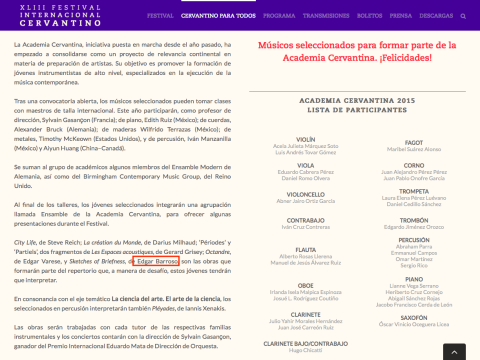
Commissioned by the International Cervantino Festival based on the city of Guanajuato – Mexico. “Kuanasi Uato” comes from two words that formed the current name of this city: Kuanasï and Uato from the Purepecha language. The name means “hill of frogs”. It was given this name because for the ancient Purepechas, it seemed that they were shaped like frogs. Because of the geographical characteristics of the city, where you can only access the city going through tunnels, the contrast in environmental changes is dramatic. Therefore contrast is very important in the piece. Kuanasi Uato is made up of different materials that collide against one another, separated, incapable of mixing. Throughout the piece, sound starts modeling the interaction among these materials until they get trapped in a flow of events which overlap constantly. This overlapping of energies create a vocabulary of gestures that compose the entire energy profile of the piece. This energy, and this piece is a sort of melancholic homage to Guanajuato, where I did my undergraduate studies and where I have dear friends and family.
——————
Comisionada por el Festival Internacional Cervantino 2012 en la ciudad de Guanajuato. “Kuanasi Uato” viene de dos palabras que forman el nombre actual de esta ciudad: Kuanasï y Uato de la lengua purépecha. El nombre significa “cerro de ranas”. Se le dio este nombre porque para los purépechas, las montañas parecían que tenían forma de ranas. Debido a las características geográficas de la ciudad, donde sólo se puede acceder pasando por túneles, el contraste de los cambios ambientales es dramático. Por lo tanto, el contraste en el material sonoro es muy importante en la pieza. Kuanasi Uato se compone de diferentes materiales que colisionan unos contra otros, separados, incapaces de mezclarse o integrarse. A lo largo de la pieza, el sonido mismo empieza a modelar la interacción entre estos materiales hasta que se quedan atrapados en un flujo de eventos musicales que se superponen constantemente. Esta superposición de las energías, comienza a crear un vocabulario de gestos que componen el perfil energético de la pieza. Esta energía, y la pieza es una especie de homenaje melancólico a Guanajuato, donde hice mis estudios de grado y donde tengo amigos y familia muy queridos.
Fylkingen is a society, consisting primarily of practicing artists, devoted to the production and promotion of new music and intermedia art. Since its foundation in 1933, initially as a chamber music society, Fylkingen has been committed to experimental, new and unestablished forms of contemporary arts. Learn more…
Tuesday 2012, September 18th – 20:30
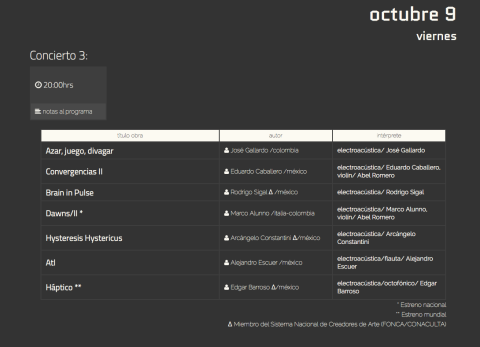
Octophonic Concert
FYLKINGEN
Münchenbryggeriet, Torkel Knutsonsgatan 2, Stockholm
Martes 18.9.2012 a las 20:30 horas
PROGRAMA
Caminando…. (recordando Nicolás Guillén) sección I (2002) Andrés Lewin-Richter
ACU (2008) Edgar Barroso
Formants B (2003) Albert Llanas
On Nothing (2003) José Manuel Berenguer
Sonatisse (2004) Pablo Fredes
Strings (1989) Andrés Lewin-Richter
Colaboran:
Generalitat de Catalunya: Consell Nacional de la Cultura i de les Arts
Ajuntament de Barcelona: Barcelona Cultura
SGAE Fundación Autor
Universitat Pompeu Fabra
Si diploma in fisarmonica con il massimo dei voti presso il Conservatorio G.Verdi di Milano con il M. Sergio Scappini, col quale continua a specializzarsi. Parallelamente studia composizione sperimentale con il M° Dario Maggi, sempre presso il Conservatorio di Musica di Milano. Ottiene presso l’Università degli Studi di Torino la Laurea in Scienze e Tecnologie dell’Arte con il Prof. Ernesto Napolitano. See more…
“ENGRAMA” will be performed at the Sanders Theater at Harvard University in February 2013.
SANDERS THEATER:
Renowned for bringing fresh excitement to traditional string quartet repertoire as well as for creating insightful interpretations of new music, the Chiara String Quartet (Rebecca Fischer and Julie Hye-Yung Yoon, violins; Jonah Sirota, viola; Gregory Beaver, cello) captivates its audiences throughout the country. During 2011-2012, the Chiara is celebrating twelve seasons of playing together.The Chiara has established itself as among America’s most respected ensembles, lauded for its “highly virtuosic, edge-of-the-seat playing” (The Boston Globe). Read more…
Ataraxia (Ἀταραξία “tranquility”) is a Greek term used by Pyrrho and Epicurus for a lucid state, characterized by freedom from worry or any other preoccupation. In this piece, the aim is to convey a state of tranquility with a very smooth flow of energy coming from the percussionist. In the score, the performer is asked to think in terms of the practice of Tai-Chi, where acceleration is very controlled and energy is somewhat contempt. The electronics on the other hand, are representing the energy, that invisible vitality coming from very soft and controlled movements, this energy is invisible to our eyes but is all around us. The piece is a state of robust tranquility that derives from surrounding oneself with trustworthy and affectionate sound world “worthy of trust”, avoiding directionality and conflict. I am very luck to have Samuel Z. Salomon to premiere this piece, he really understood the piece right from the beginning and his incredible sensitivity and musicianship are truly remarkable.
UTTERANCE
For non-native speakers, utterance is a word that comes with a lot of confusing pronunciations, meanings and usages. This piece is an homage to a friend of mine who spent a long evening conversation explaining to me (and others) what is the meaning of the word Utterance and when it is a appropriate to use it. Is it pronunciation? Is it mention? Is it expression? Is it a style of communication? Is it all of them? Since Frank Wörner comes from Germany and I will soon move to Switzerland I decided to use German and English to convey distance from the absolute understanding of the word Utterance.
The piece is an absurd dialogue between the singer and a second character who is “inside” a single speaker and that will be interrupting and explaining the meaning of Utterance to Frank. The learning experience makes use of singing, speaking, laughing, shouting and what the performer feels at the moment of listening to what the speaker has to say. It has a controlled level of improvisation, making the piece be halfway into a small music theater monologue-dialogue between him and his many selves. An absurdist fiction that was not that far away from that original conversation among friends on the topic of Utterance.
Listen to the recording:
Works by:
Justin Hoke
Sivan Cohen-Elias
Edgar Barroso
Chaya Czernowin
Andreas Dohmen
ARTS@DRCLAS is pleased to announce the second version of its SPRING MUSIC CONCERT SERIES. Each year Latino and Latino American musicians from Harvard and the Boston area are invited to play at The David Rockefeller for Latin American Studies.
Program 1: Composer Andres Ballesteros
Nora and Reshma’s Magical Tandem Bike Ride
Sin Tregua
Program 2: Composer Edgar Barroso
ACU – Electroacoustic piece
Kapsis – For Video and Electronics
Binary Opposition – for video and electronics
Program 3: Trio Clave: Carmen Liliana Marulanda (Traverse flute), Fabián Gallón (Tiple) Arístides Rivas (Violoncello)
Gloria Beatríz – Bambuco de León Cardona
Bochicaneando – Bambuco de Luis Uribe Bueno
El Sanjuanero Huilense by composer Anselmo Durán.
Marielena – Danza de José A. Morales
Carito – Bambuco de Luis Carlos Saboya
El Patasdilo – Pasillo de Carlos Vieco Ortíz
All arrangements by Carmen Liliana Marulanda, except Carito, by Lucas Saboya.
OVER-PROXIMITY
For Flute, Clarinet, Horn, Trombone, One Snare Drum, Two Maracas and Piano.
We are now so close to each other. Social networks have been sharing our lives, ideas, pictures, videos to the world since some years ago. These hyper-connectivity has created the possibility to maintain relationships that otherwise would not be possible, such as long distance relationships and online collaboration. Nonetheless, despite all these advantages, this over-proximity to our lives, has brought a new form of stress to society. What we published in these networks could make somebody else uncomfortable, upset, even miserable, and could be someone that you don’t even know. Your “happiness” expressed in your pictures, could be a trigger of someone else’s depression at the other side of the world. People are now comparing to one another constantly. This piece is an exploration of musical materials that are too close to each other, either rhythmically, energetically, or referring to pitch content. This piece is a personal reflection on the consequences that we produce when we published something on the web. The music material was created thinking in the Over-Proximity idea of having people looking at others people’s lives. A given in today’s world.
Inspired by Slavoj Zizek idea of over-proximity and social networks in the new social revolution yet to come.
“Why are we so traumatized by the neighbor’s over proximity? Habit and custom are the predominant ways in which we maintain a distance towards the “inhuman” neighbor’s intrusive proximity, and we are today effectively witnessing a decline of habits: in our culture of self-exposure and “sincerity”, they no longer provide a screen ensuring our distance from the neighbor.”
Slavoj Zizek “Living in the End Times”
A previous version performed by:
Jennifer Ashe – Soprano
Philipp Stäudlin – Saxophone
“An inward flow” is a piece inspired by “Untitled” by Robert Gober. The piece immediately caught my imagination as an object that is actively hiding a deep secret. It seems to me that the object somehow swallowed the little girl(s), they are sisters. Nonetheless, the intention of the sink is not to hurt the little girl(s), but to confine them into a space to resolve some issues between them, only then can they come out of it. In this piece, the “trapped” character(s) are played by a mezzosoprano. The sink on the other hand is represented by the saxophone and the resonant environment in which this objects are interacting is mainly assigned to the live electronics part. A fragmented/dislocated dialog between these sisters begin, the girl(s) “trapped” in the sink are forced to find a way out by resolving some issues between “them”. Presumably egoistic problems. In the process, they finding a huge conflict in communication and pretty much start a very hostile and hurtful dialogue. Could they stop being so full of themselves and free themselves from the sink?
The Edge of Our Thinking is an inaugural student-led research conference investigating a range of current perspective in art and design. Professional researchers and research students from across the UK will hold presentations and workshops in a variety of practical and theory-based subject areas, offering the unique opportunity for critical interdisciplinary exchange.